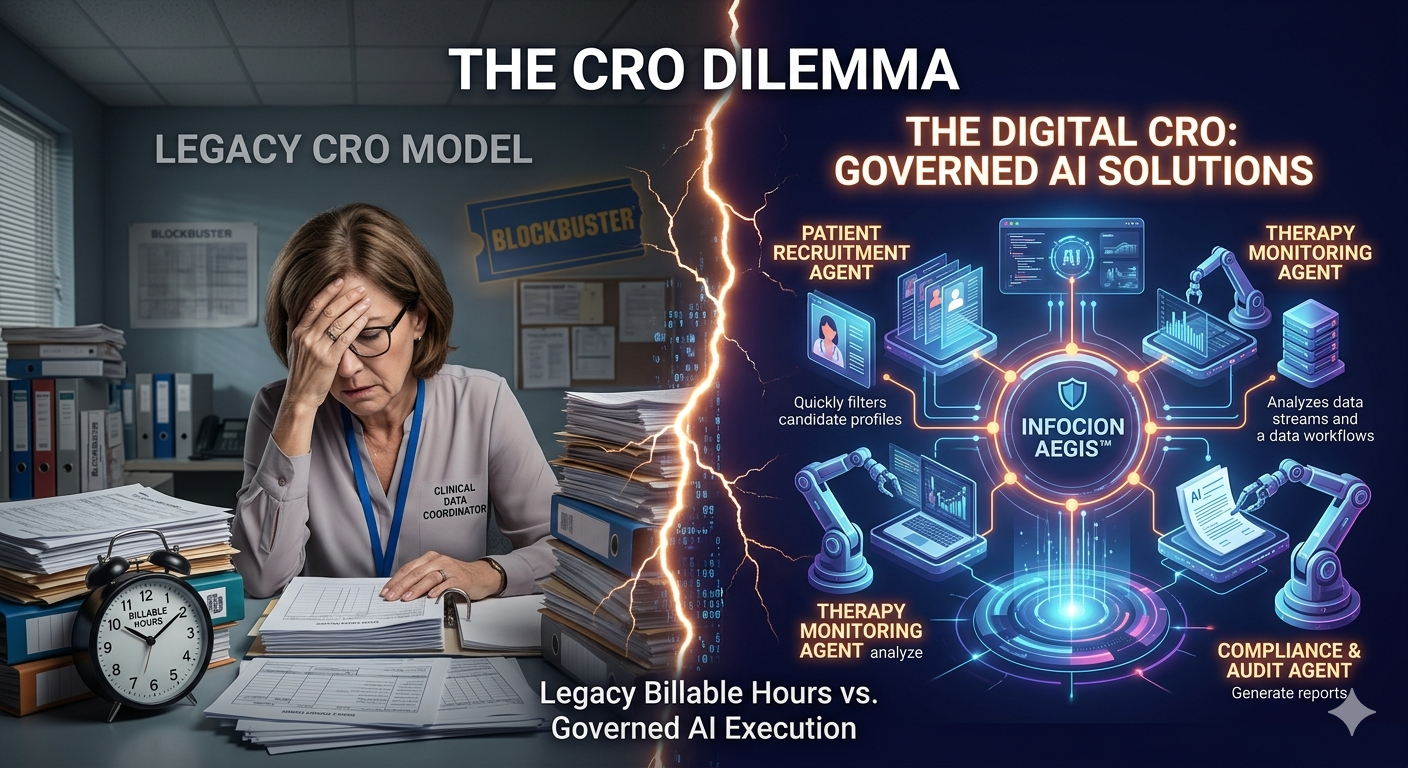

The clinical research industry is facing a pivotal transformation.
For decades, Clinical Research Organizations (CROs) have operated on a labor-arbitrage model. Revenue was tied to human hours: manual patient recruitment, manual data monitoring, and manual site management. In this environment, inefficiency was—uncomfortably—profitable.
But as we enter the era of Agentic AI, the ground is shifting. The very tasks that CROs once billed thousands of hours for are now being automated by Sponsors at the click of a button.
The Productivity Trap
Many CROs are hesitant to lean into AI for a simple, defensive reason: Cannibalization. If an AI agent can identify and screen 1,000 patients in seconds—a task that previously took a team of clinical coordinators weeks—how does the CRO justify its traditional fee structure?
The fear is that by adopting Agentic AI, CROs might be coding themselves out of a paycheck. However, while some CROs hesitate, Sponsors are moving. As of 2026, pharmaceutical sponsors are increasingly gaining direct access to advanced AI solutions for patient recruitment. They are no longer willing to pay for manual labor when they can pay for speed and clinical precision.
History Repeats: The Dot Com Warning
We’ve seen this movie before.
- In the late 90s, travel agencies thought the internet would never replace the “human touch” of booking a flight.
- In the early 2000s, Kodak believed digital photography was a niche hobby that wouldn’t touch their film revenues.
- Blockbuster famously turned down the chance to buy Netflix because they couldn’t see past their “late fee” revenue model.
Companies that cling to a legacy revenue model in the face of a 10x technology shift don’t just lose margins—they lose their seat at the table.
The Shift from Labor to Results
The CROs that thrive in this new landscape won’t be the ones with the largest staff; they will be the ones with the most sophisticated Governed AI strategies.
The transition is moving away from “How many hours did you work?” toward “How fast did you reach the milestone?” This is a shift from Labor Arbitrage to Value-Based Outcomes. Agentic AI doesn’t just reduce work; it reduces Risk and Time-to-Market. For a Sponsor, a trial finished three months early is worth millions more than a slight discount on hourly rates.
The Path Forward: Governed AI as Infrastructure
At Infocion, we believe the future of clinical research is not “Human vs. AI,” but Human-Governed Autonomy. The goal isn’t just to use AI, but to use Governed AI that is safe, auditable, and compliant. Through our Aegis™ Governance Platform, we are helping CROs and Sponsors deploy Agentic AI solutions that don’t just “assist” but actually “execute” within strict regulatory guardrails.
Whether it is our Patient Recruitment Agent or real-time therapy monitoring, we provide the control plane that ensures these systems are:
- Safe & Compliant: Adhering to FDA, HIPAA, and GxP standards.
- Auditable: Providing the immutable proof required for regulatory submissions.
- Model-Agnostic: Orchestrating the world’s best intelligence—from Claude to Gemini—inside a secure perimeter.
The choice for CROs is stark: You can protect your legacy billable hours until they disappear, or you can lead the transition to a high-margin, tech-enabled future. You either hop on board the AI shift, or you risk being left behind in a “Dot Com” style extinction event.
Is your organization ready to lead the shift to Governed AI? Let’s discuss how Infocion can harden your clinical AI strategy.